Litigation Support
The Facts Your Case Turns On. Found, Documented, Defensible.
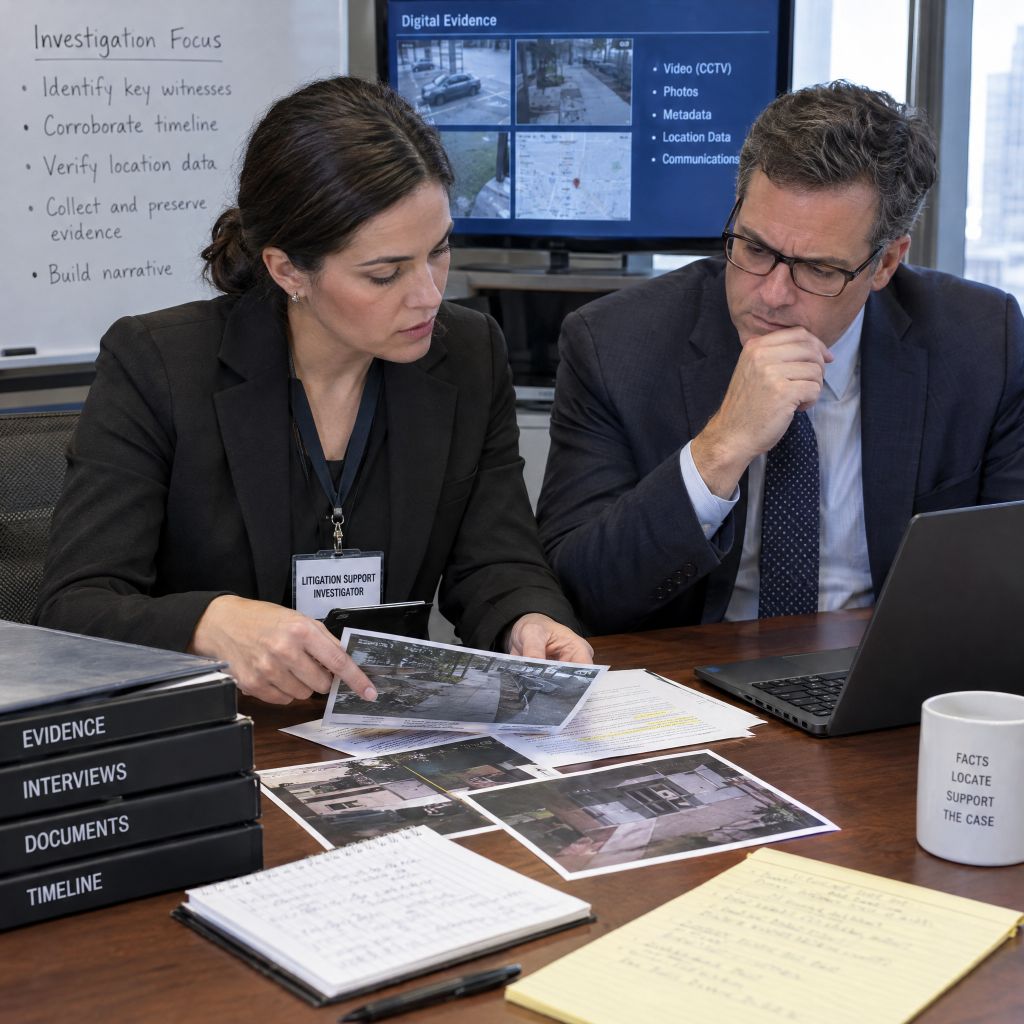
Good litigation support finds the facts the other side did not expect you to have. Think of the witness nobody could find, or the LLC formed three weeks after the complaint. It might be the deleted message that was not actually gone. Or it might be the pattern that turns one incident into a course of conduct. Our licensed investigators find those facts and document them to withstand cross-examination. Then we deliver them in a form your team can use.
Florida Class A Private Investigative Agency · License No. 3500181 · Confidential
An Intelligence Capability for Your Litigation Team.
Litigation support is the investigative work that sits beside the legal work. We locate and interview witnesses and establish what a party owns and controls. We also document fraud and misconduct and recover and authenticate digital evidence. Together, that work builds the factual record your pleadings, discovery requests, and trial strategy depend on. However, attorneys cannot be witnesses to the facts they argue. And most firms have no staff investigators who can testify to how they gathered evidence. We fill that gap.
Tactical Rabbit is not a records-pull service. Our team includes former CIA, FBI, and Military Intelligence personnel. It also includes former law enforcement and financial-crimes professionals. So we work a litigation matter the way an intelligence agency works a target. We define the question, identify the sources, collect lawfully, and corroborate. Then we report with an honest statement of confidence. If a matter also warrants a criminal referral, the same evidence package feeds our Law Enforcement Liaison work.
Our Intelligence Director, Everett Stern, is the HSBC money-laundering whistleblower. He built his evidence to survive scrutiny from regulators, prosecutors, and the bank’s own counsel. We hold our litigation work to that same standard.

Cases Are Rarely Lost on the Law.
A judgment against a defendant with nothing in his own name. A key witness who could not be served. A fraud claim pleaded on information and belief because no one traced the money trail. A spoliation motion that failed because an IT contractor imaged the device with no chain of custody. Or a settlement accepted on the other side’s financial disclosures, which later turned out to be incomplete.
None of those outcomes came from bad lawyering. Instead, the investigative work was skipped, came too late, or came from someone who could not testify. Litigation support closes those gaps before they cost the case. First, it tells you at the outset whether a defendant is collectible. It also finds the witnesses before the deadline. It documents the fraud so the complaint can plead it with particularity. Finally, it preserves the evidence in a form the court will accept.
WITNESS IDENTIFICATION & LOCATION
Every case has witnesses who are not in the pleadings. Think of the former employee who saw the books, or the neighbor who heard the argument. It might be the vendor who heard the same story, or other victims of the same scheme. We identify them from records, open sources, and human intelligence. Then we locate them, even those who moved, changed names, or do not want to be found. Finally, we conduct lawful, documented interviews. As a result, counsel knows what each witness will say before deposition.
- Witness identification: Who else has knowledge of the facts, developed from records, filings, social media, and interviews.
- Skip tracing and location: Current addresses and contact details for witnesses and parties, so you can serve process and deposition subpoenas.
- Witness interviews and statements: Recorded or written statements taken lawfully and documented, with the investigator available to testify to them.
- Witness profiling: Background, credibility indicators, prior statements, litigation history, and bias, for both your witnesses and theirs.
- Adverse witness and expert vetting: Credentials, prior testimony, publications, and disciplinary history of the other side’s witnesses and experts.
Can you find a witness who is avoiding service?
Usually. Skip tracing combines records, open-source intelligence, and field work. We report the location, the basis for it, and our confidence level. We can also coordinate with your process server.
Will the investigator who took the statement testify?
Yes. Our investigators document how they conducted each interview. They are also available for deposition and trial.
ASSET DISCOVERY & FINANCIAL FORENSICS
A judgment is worth what you can collect. Before you file, an asset profile tells you whether the defendant is collectible. Before you settle, it tells you what the other side can actually pay. After judgment, it tells your team where to direct garnishment, levy, lien, and post-judgment discovery. We locate real property, business interests, vehicles, vessels, and aircraft. We also develop lawful indicators of bank, brokerage, and retirement accounts. In addition, we identify recent transfers, nominee owners, and entities used to hold assets out of reach.
Our Intelligence Director exposed HSBC’s money laundering, so we know how people hide money. That is how we find it.
- Pre-suit collectability assessment: A documented view of what a prospective defendant owns and controls, so you can decide whether to file.
- Settlement intelligence: The real financial picture on the other side of the table, including assets held through entities, trusts, and family members.
- Fraudulent transfer identification: Conveyances to relatives, associates, and affiliated entities. We also supply the dates and documents your team needs to challenge them.
- Account indicators: Lawful indicators of financial accounts, drawn from litigation history, UCC filings, property transactions, and business records. They direct subpoenas and post-judgment discovery.
- Judgment enforcement support: Asset profiles built for garnishment, levy, lien, and debtor examinations, coordinated with your counsel.
- Transaction tracing: Where money went in fraud, embezzlement, and partnership disputes: accounts, entities, and the people who controlled them.
Can you get bank account balances?
No, and no licensed investigator lawfully can. Federal law prohibits obtaining financial account information through pretexting. Instead, we lawfully develop indicators of where accounts exist. That is what your team needs to subpoena the records. Firms that promise balances are either breaking the law or selling something they cannot deliver.
How is this different from an online asset search?
An online service delivers a database pull matched to a name. By contrast, we deliver an investigation. We find the LLC formed after the complaint and the registered agent who is the debtor’s brother-in-law. We find the boat an affiliated entity bought last spring. In short, we follow the people as well as the paper.
FRAUD & MISCONDUCT INVESTIGATIONS
Fraud claims demand specifics: who said what, to whom, when, and what happened as a result. So we investigate and document the whole scheme. That includes the misrepresentations, the money, the entities, the actors, and the pattern across other victims. As a result, counsel can plead the complaint with particularity and prove the case. The same work also supports breach of fiduciary duty, embezzlement, and partnership and shareholder disputes. It supports employment misconduct and trade-secret claims, too.
- Scheme reconstruction: A sourced timeline of the conduct, built from documents, records, interviews, and digital evidence.
- Subject identification: Who was involved, including nominees, affiliated entities, and individuals behind anonymous accounts.
- Pattern evidence: Other victims, prior schemes, and related litigation that establish intent and course of conduct.
- Corporate and counterparty intelligence: Ownership, affiliations, regulatory history, and undisclosed interests of the parties.
- Evidence packages: Indexed exhibits with provenance, organized for discovery, motion practice, and trial.
- Parallel criminal referral: Where the conduct is criminal, a referral package for law enforcement is prepared alongside the civil case.
Law Enforcement Liaison
DIGITAL EVIDENCE & FORENSICS
Some matters turn on what happened on a device, in an email account, or in a cloud system. In those cases, how you acquire the evidence decides whether the court will accept it. Our examiners image devices and accounts forensically and maintain chain of custody. They also authenticate with cryptographic hashes, recover deleted and hidden data, and reconstruct the timeline. Finally, they document their methodology and are available to testify to it. By contrast, a device an IT vendor examined without those steps is an exhibit waiting to be excluded.
- Forensic preservation: Verified, bit-for-bit images of computers, phones, and cloud accounts, with documented chain of custody.
- Recovery and authentication: Deleted files and messages, metadata, timestamps, and evidence of anti-forensic activity.
- Email and account analysis: Headers, authentication trails, mailbox rules, and access logs that show who did what and when.
- Data theft and exfiltration: USB history, cloud uploads, and personal-email transfers in trade-secret and employment matters.
- Expert reports and testimony: Examiners’ reports written for counsel, with the examiner available for deposition and trial.
- Spoliation analysis: Whether and when evidence was destroyed, and what can be reconstructed from backups, logs, and other sources.
INTELLIGENCE BRIEFS & RECORDS RESEARCH
An intelligence brief is a sourced, validated assessment of the people, companies, and facts in a matter. We write it for the decision counsel has to make. That might be whether to file, how to plead, or whom to depose. It might also be what to request in discovery, or what the other side will likely do. To build it, we draw on public records in every relevant jurisdiction, plus corporate and UCC filings. We also use litigation and regulatory history and open-source and social-media intelligence. Where appropriate, we add public-records requests under FOIA and state sunshine laws.
- Pre-litigation assessment: The facts, parties, and collectability of a prospective matter, before the retainer is spent.
- Party and opposing-counsel intelligence: Litigation history, prior positions, affiliations, and reputational signals.
- Public-records research: Court filings, property and business records, regulatory actions, and licensing data across jurisdictions. Open Source Intelligence (OSINT)
- Government records: We prepare, file, and follow up on FOIA and state public-records requests. FOIA Request Preparation
- Due diligence: Executive, counterparty, and pre-transaction vetting that goes beyond a database check. Background Investigations & Due Diligence
- Discovery support: Identifying what to request, from whom, and where the records are likely to exist.
How Our Litigation Support Works
- Confidential intake: A protected conversation with counsel, or with the client and counsel together. We cover the matter, the deadlines, and the questions the investigation must answer.
- Scope and engagement: A written scope with deliverables, timeline, and fee. Where privilege matters, counsel engages us, so we prepare work product at the attorney’s direction.
- Preserve: We preserve devices, accounts, records, and communications before anything is lost. We also support litigation holds where needed.
- Investigate: We run records research, open-source intelligence, witness work, financial forensics, and digital forensics, as the matter requires.
- Report: We document findings with sources, index exhibits, and state confidence levels. We also separate what is confirmed, what is indicated, and what we could not establish.
- Testify: Our investigators and examiners are available for affidavits, depositions, and trial. They also explain methodology under cross-examination.
Who We Work With
- Litigation and trial attorneys: Commercial, fraud, employment, family, and personal-injury practices that need investigative capacity they can put on the stand.
- Plaintiffs and litigation funders: Parties evaluating whether a claim is worth pursuing and whether a judgment can be collected.
- Creditors and judgment holders: Banks, lenders, and businesses enforcing judgments against debtors who have moved assets out of reach.
- Family-law counsel: Divorce and custody matters where a spouse controlled the finances or the disclosures are in doubt.
- Corporate counsel: Internal investigations, partnership and shareholder disputes, trade-secret and insider-threat matters, and pre-transaction diligence.
- Bankruptcy trustees and creditors’ committees: Testing whether a debtor’s schedules are complete and whether pre-filing transfers were legitimate.
Deadline approaching, or evidence at risk?
Witnesses move, devices get wiped, and assets get transferred the moment a dispute becomes visible. That is why preservation and location work are most effective early. Speak with a licensed investigator before the window closes.
Why Choose Tactical Rabbit for Litigation Support
- Intelligence-community methods: Our team includes former CIA, FBI, and Military Intelligence personnel and former law enforcement and financial-crimes professionals. They apply agency-grade tradecraft to civil matters.
- Built to testify: Every report is sourced, and every exhibit has provenance. In addition, every investigator and examiner is available for deposition and trial.
- One agency, the whole problem: Witness work, asset discovery, fraud investigation, digital forensics, and records research come under one engagement. As a result, nothing falls between vendors.
- We know how money hides: Our Intelligence Director exposed HSBC’s laundering for drug cartels and sanctioned entities. Our asset and fraud work starts from that understanding.
- Licensed and accountable: Florida Class A Private Investigative Agency No. 3500181, operating under Chapter 493. Our Intelligence Director holds Class C License No. C3400428. We assist clients nationwide, working with licensed partners where required.
FAQ
What does litigation support from Tactical Rabbit include?
Our litigation support covers witness location and interviews, asset discovery, and fraud investigation. It also includes digital forensics and intelligence briefs. Licensed investigators do the work, document it for counsel, and testify to it when needed.
Are your findings admissible in court?
We work to evidentiary standards, document chain of custody, and write reports for counsel. Our investigators and examiners are available to testify. However, the court decides admissibility, and your attorney handles that question. We are not a law firm.
Can we engage you through our firm to protect work product?
Yes. Counsel retains us on most litigation engagements, and we work at the attorney’s direction. Discuss privilege structure with your attorney. We will follow the engagement terms counsel sets.
How quickly can you locate a witness or a party?
We complete many locates within days. However, harder cases take longer, such as a person actively avoiding contact or who has changed identities. Either way, we tell you the expected timeline at intake.
Can you obtain bank, phone, or medical records?
Not directly. Your team obtains those records through subpoena. Instead, we develop the lawful indicators that tell your team where to subpoena. We do not use pretexting or any unlawful method.
Do you conduct surveillance?
Yes, where it is lawful and relevant. Licensed investigators conduct it and document it for use in the matter. We will also tell you when surveillance is unlikely to be productive.
Do you work outside Florida?
Yes. We assist clients nationwide. However, where the law requires it, we work with licensed partners in other states.
Can the same investigation support a criminal referral?
Yes. Where the conduct is criminal, our Law Enforcement Liaison team prepares a referral package from the same evidence. We build it for the agency and unit with jurisdiction.
What does it cost?
We scope and quote each engagement in writing after intake. Before you commit, we tell you plainly whether an investigation is likely to be worthwhile.
Disclaimers
Tactical Rabbit LLC is a Florida Class A Private Investigative Agency (License No. 3500181) operating under Chapter 493 of the Florida Statutes. We are not a law firm and do not provide legal advice. Investigative findings are prepared for use by the client and counsel; the admissibility of any evidence and the use of findings in any proceeding are determined with counsel and by the court.
We obtain information only through lawful sources and methods. We do not use pretexting to obtain financial, telephone, medical, or other protected records, and we work within federal and state privacy law. No outcome in any legal matter is guaranteed, and none should be inferred from any engagement or communication with Tactical Rabbit.
Strengthen Your Case With Facts That Hold Up.
Speak confidentially with a licensed investigator about the matter and the deadlines. Then learn what an investigation can establish.
Tactical Rabbit LLC · Florida Class A License No. 3500181 · Licensed by the Florida Department of Agriculture & Consumer Services · Services Compliant with Florida Statutes Chapter 493
Asset searches, digital forensics, OSINT, and fraud investigations: the capabilities behind every litigation engagement.
Criminal referral packages prepared alongside the civil case.
Government records obtained through FOIA and state public-records law.